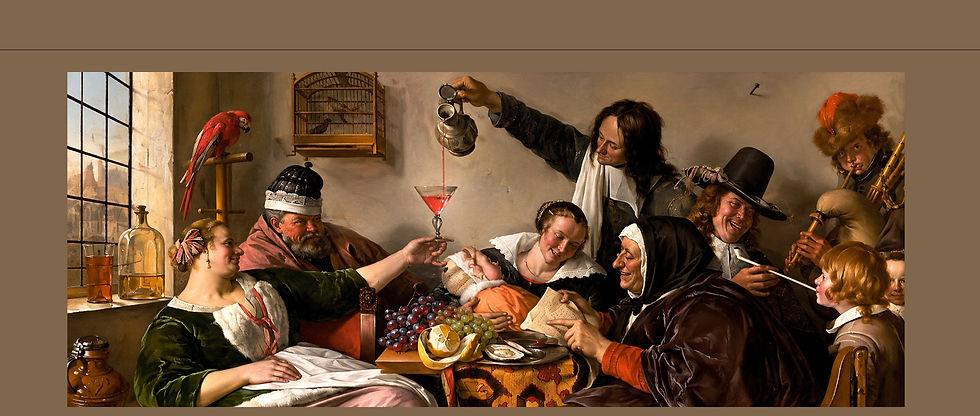
Peinture du domaine public par Jan Steen 1600
En 2007, les archéologues de l'UCLA ont trouvé ce qui semble être un domaine viticole situé dans un Arménien grotte qui remonte à 4100 avant notre ère. Il contenait des restes de vigne, des récipients à boire, un pressoir à vin et des pots de poterie pour le stockage.
Cependant, personne ne sait quand le vin a été inventé pour la première fois. De nombreux chercheurs pensent qu'il remonte à 6000 avant notre ère. L'art, les fouilles archéologiques et les écrits nous montrent que de nombreuses civilisations utilisaient le vin dans les cérémonies, la religion, les occasions spéciales, en médecine et à la maison.
Dans les années 1500, la production de vin a été tentée en Floride, en Virginie et au Canada dans les années 1600, mais les missions espagnoles sont responsables de l'introduction de la vigne en Californie dans les années 1700, qui a marqué le début de l'industrie vinicole américaine. En 1805, ils ont établi la première cave de Sonoma. L'industrie vinicole californienne a explosé dans les années 1800 en raison de la ruée vers l'or et du problème du phylloxéra en Europe. Le phylloxéra est insectes microscopiques qui mangent les racines de la vigne. Ainsi, pendant de nombreuses décennies, l'Europe n'a pas pu produire de vin. Les ventes de vin ont de nouveau grimpé en flèche dans les années 1990 parce que les microbrasseries artisanales prenaient le contrôle du marché de l'alcool et que l'industrie du vin voulait rivaliser. Jusque-là, vos choix de vins dans un restaurant étaient simplement du Bourgogne, du Chablis ou du rosé, mais dans les années 1990, les restaurants proposaient jusqu'à cent bouteilles de vin sur leurs menus.
Principales choses à propos du vin
Personne ne sait quand le vin a été inventé pour la première fois.
Le vin est fabriqué à partir de fruits fermentés. Le fruit le plus utilisé est le raisin.
Même s'il existe plus de 10 000 variétés de raisins dans le monde, seulement 300 environ sont utilisées pour le vin commercial.
Le jus de tous les raisins est clair. Ce sont les peaux qui lui donnent sa couleur.
La France et l'Amérique sont les principaux producteurs de vin, et les cinquante États américains fabriquent du vin.
Appellation signifie où (géographiquement) les raisins ont été cultivés.
Vintage signifie quelle année les raisins ont été récoltés.
Il faut environ 600 raisins pour faire une bouteille de vin, et il y a 50 millions de bulles dans une bouteille de champagne.
À Thanksgiving, les Américains boivent plus de vin que n'importe quel autre jour de l'année.
Les cocktails les plus populaires à base de vin sont French 75, Sangria, Champagne Cocktail, Wine Spritzer, Kir, Kir Royale, Mulled Wine, Americano, Martini et Manhattan.
Types De Vin
Vin rouge
Le vin rouge est élaboré à partir de raisins noirs. Les raisins noirs ont une couleur rouge-bleuâtre. Les peaux de raisin sont utilisées lors de la production. Pour faire des vins de couleur rose comme le rosé et le Zinfandel blanc, les peaux sont laissées un peu puis jetées. Les cépages rouges commerciaux populaires sont le cabernet, le merlot, le pinot noir, le zinfandel et le beaujolais.
Vin blanc
Le vin blanc est fabriqué à partir de raisins qui apparaissent vert clair. Le vin blanc peut également être fabriqué à partir de raisins noirs si les peaux ne sont pas utilisées. Les cépages blancs commerciaux populaires sont le Chardonnay, le Pinot Grigio, le Riesling et le Sauvignon Blanc.
Vin fortifié
« Enrichi » signifie que des ingrédients tels que du sucre, du brandy, des herbes ou des plantes ont été ajoutés au vin. Ceux-ci incluent le sherry, le porto, le Madère et les vermouths. Les trois premiers sont souvent appelés vins de dessert.
Vin pétillant
Le vin mousseux est la boisson alcoolisée numéro un utilisée pour célébrer des occasions telles que les mariages, les anniversaires et les anniversaires. Tout comme les Post-it, la Super Glue et la pénicilline, le vin mousseux est le résultat d'un heureux accident.
Le nord de la France (région de Champagne) a une courte saison de croissance et pendant l'hiver, la fermentation s'arrêtait à l'intérieur des bouteilles de vin. A l'approche du printemps, la température montait, la fermentation recommençait et les bouteilles de vin éclataient. Un moine bénédictin français nommé Dom Pérignon a passé la majeure partie de sa vie d'adulte - jusqu'à sa mort en 1715 - à essayer de trouver un moyen d'arrêter les bulles.
Au début des années 1800, la maison Veuve Clicquot (dirigée par une femme) a résolu de nombreux problèmes de champagne en utilisant des bouteilles plus épaisses, de meilleurs bouchons et des remuages (faire sortir le sentiment au fond de la bouteille). Des pays comme l'Italie, l'Espagne et les États-Unis. par la suite, ils ont commencé à apposer le mot «champagne» sur leurs étiquettes de vins mousseux, ce qui a déclenché la guerre du champagne. En 1919, des lois ont été adoptées exigeant que seul le champagne produit dans la région de Champagne en France puisse utiliser le mot «champagne» sur son étiquette. Aujourd'hui, l'Italie qualifie son vin mousseux de « prosecco » ; L'Espagne l'appelle cava et les États-Unis utilisent simplement le terme «vin mousseux».
Mots à connaître sur le vin
Mélanger
Assemblage de différents vins.
Corps
Poids et ampleur d'un vin, que vous pouvez discerner lorsque vous l'avez en bouche.
Bordeaux
La région du sud-ouest de la France considérée comme l'une des meilleures régions viticoles du monde.
Brut
Français pour "sec".
Demi-sec
Terme français signifiant « à moitié sec ».
Finir
Le goût dans la bouche après avoir avalé du vin.
Sulfites
Un sous-produit naturel du processus de fermentation du vin.
Tanin
Les peaux de raisin contiennent des tanins et le goût est sec ou astringent comme une tasse de thé fort.
Cépage
Cépage principal dont est issu le vin.
Vintage
L'année où les raisins ont été récoltés.
Faits amusants sur le vin
Le champagne est disponible en huit tailles de bouteilles. Le plus grand s'appelle Nabuchodonosor et équivaut à vingt bouteilles standard de 750 ml.
En 1863, le chimiste français Angelo Mariani a infusé du vin de Bordeaux avec trois types de feuilles de coca dans la bouteille et l'a appelé Vin Tonique Mariani. Deux onces contenaient douze milligrammes de cocaïne. Il était techniquement vendu comme un médicament qui agissait comme un coupe-faim, un stimulant de l'estomac et aidait à lutter contre la dépression. Il a remporté une médaille d'or du Vatican après que le pape saint Pie X et le pape Léon XIII l'ont approuvé. De plus, on pense qu'il y avait plus de 7 000 avenants rédigés par des médecins. En 1884, John Pemberton d'Atlanta, en Géorgie, a remplacé le vin par de l'extrait de cola et du soda et Coca-Cola est né.
Pendant la prohibition américaine, le concentré de jus de raisin était vendu avec des instructions sur la façon de ne pas le laisser fermenter - en gros, en disant aux consommateurs comment faire du vin à la maison.
James Bond est peut-être connu pour ses Vodka Martinis, mais dans les romans et les films, il boit du champagne plus que n'importe quel alcool.
Si une bouteille de vin est bouchée avec du vrai liège, rangez la bouteille sur le côté afin que le bouchon ne se dessèche pas.
Soyez prudent lorsque vous ouvrez une bouteille de champagne et ne dirigez jamais le bouchon vers une personne ou un objet cassable, car le bouchon peut sortir à 160 km/h.
Madère est mentionnée dans la pièce de William Shakespeare Henry IV, première partie lorsque Falstaff est accusé d'avoir échangé son âme contre une cuisse de poulet et un calice de Madère.
En 2004, le film indépendant à succès Sideways a fait tourner la langue des barmans en disant Pinot Noir cent fois par nuit.
Toutes les trois semaines de novembre, vous pouvez consommer un sentiment d'unité avec le monde en buvant le même vin - en même temps - avec vos frères et sœurs mondiaux. Il s'intitule « C'est l'heure du Beaujolais Nouveau ! Le Beaujolais Nouveau (BOH- zoh -LAY NO- voo ) est mis en bouteille six à huit semaines après la récolte et est distribué dans le monde entier en une semaine. Cela permet de partager l'expérience. Regardez la lune en buvant et vous partagerez deux expériences en même temps.
La plus grande bouteille de vin du monde est l'enseigne du Boondocks Lounge à Tucson, en Arizona.
Off topic, but worth knowing: Bad for wine, great for absinthe. With wine scarce and expensive during the phylloxera crisis (roughly 1863 to the 1890s), absinthe—made from wormwood, not grapes—became the cheap, widely available alternative for the masses. Its sales exploded during those same decades, and it became the signature drink of the Belle Époque, embraced by artists and writers looking for something to drink now that wine wasn't an option. Once European vineyards recovered, the wine industry didn't take kindly to the competition—and helped fuel the propaganda campaign that got absinthe banned in France in 1915. It worked. To this day, bartenders still get asked if absinthe causes hallucinations, drives you to kill your family, or makes an artist cut off his own ear. It was a media war fought entirely with posters and
rumors—no TV, no internet, not even air conditioning.
The Top 10 Things to Know About Wine
• No one knows exactly when wine was first invented.
• Italy, France, and Spain are the world's top wine producers, and all fifty U.S. states make wine.
• It takes about 600 grapes to make a bottle of wine, and there are roughly 50 million bubbles in a bottle of Champagne.
• Appellation means where (geographically) the grapes were grown.
• Vintage means what year the grapes were harvested.
• On Thanksgiving, Americans drink more wine than on any other day of the year.
Rosé isn't made by mixing red and white wine—except in Champagne, where it's the one region actually allowed to do exactly that.
• A screw cap doesn't mean a wine is cheap. Many respected producers, especially in New Zealand and Australia, use them specifically because they eliminate cork taint entirely.
• Not all wine is vegan. Some producers use animal-derived products like egg whites, gelatin, or fish bladders to clarify wine before bottling.
• Popular wine cocktails include French 75, Sangria, Champagne Cocktail, Wine Spritzer, Kir, Kir Royale, Mulled Wine, Americano, and Aperol Spritz.
• Champagne can only be made in the Champagne region of France, using specific grapes (mainly Chardonnay, Pinot Noir, and Pinot Meunier) grown within that exact legally defined area, and produced using the traditional method—a second fermentation that happens inside the bottle itself. And yet, you can still find a handful of American bottles with the word "Champagne" printed right on the label, perfectly legal.
The U.S. Champagne Loophole & Wait, why does California Korbel say Champagne on the label?
In 1919, the Treaty of Versailles legally protected "Champagne" as a name belonging only to the Champagne region of France.
But the U.S. Senate never actually ratified that treaty. America signed a separate peace deal with Germany in 1921 that never mentioned Champagne at all—leaving American wineries free to use the word for decades while the rest of the world couldn't.
That loophole finally closed in 2006, when the U.S. and the EU signed a trade agreement restricting "Champagne" to the real thing going forward. But the deal included a grandfather clause: any American winery already using the name before March 10, 2006, could keep using it forever, as long as they labeled it
"California Champagne." Korbel had been calling itself Champagne since 1882, so it made the cut.
CONFIRMED GRANDFATHER BRANDS USING "CHAMPAGNE" ON THEIR LABELS
-
Korbel (California Champagne)
-
Cook's (Cook's Champagne)
-
André (owned by E. & J. Gallo)
-
Barefoot Bubbly (owned by Gallo)
-
Tott's (owned by Gallo)
-
Ballatore (owned by Gallo)
-
Wycliff
Types of Wine
Red Wine
Red wine is made from black grapes—which, just to keep things confusing, are usually more reddish-blue or purple than actually black.
Winemakers leave the grape skins in contact with the juice during production, giving red wine its color, tannins, and much of its character. Popular red wine grapes include Cabernet Sauvignon, Merlot, Pinot Noir, Zinfandel, and Gamay (the grape behind Beaujolais). Apparently calling them “purplish-reddish-blue grapes” was too much for the wine list.
White Wine
White wine is generally made from light-green grapes. But here's the fun part: white wine can also be made from black grapes if the skins are removed before they can color the juice.
Popular white wine grapes include Chardonnay, Pinot Grigio, Riesling, and Sauvignon Blanc. Wine lesson #1: Never judge a wine by the color of its grape.
Rosé Wine
Rosé gets its pink color from black grapes, too. The skins stay in contact with the juice briefly—from a few hours to a couple of days—then are removed before they can contribute the deeper color of a red wine. White Zinfandel is one of the most familiar American examples.
There's one notable exception: in Champagne, producers are permitted to make rosé by blending a small amount of red wine into white wine—a method generally prohibited for still rosé wines in the European Union.
Basically, rosé is red wine that didn't spend enough time with its skins to commit to the relationship.
Orange Wine
Orange wine isn't made from oranges. It's white wine made more like red wine, with the grape skins left in contact with the juice for days, weeks, or even months. That skin contact creates its amber-orange color along with more tannin and texture than you'd normally expect from a white wine.
It's an ancient winemaking method, thousands of years old, that has made a major comeback with the natural-wine movement.
So no oranges. No orange juice. And definitely no garnish required.
Fortified Wine
Fortified wine is wine to which a distilled spirit—usually grape brandy—has been added, increasing its alcohol content. Sherry, Port, and Madeira are classic examples. Vermouth is both fortified and aromatized with herbs, spices, and other botanicals.
Port and many Madeiras can be served as dessert wines, while sherry ranges from
bone-dry styles such as Fino and Manzanilla to richly sweet versions.
In other words, somebody looked at wine and thought, “You know what this needs? More alcohol.”
Sparkling Wine
Sparkling wine is practically the official alcoholic beverage of weddings, birthdays, anniversaries, promotions, New Year's Eve, and anything else that seems worthy of popping a cork. And like Post-it Notes, Super Glue, and penicillin, sparkling wine owes part of its history to a happy accident.
Northern France's Champagne region has a cool climate, and historically, winter temperatures could interrupt fermentation. When spring arrived and temperatures rose, fermentation could restart inside the bottles, producing carbon dioxide—and sometimes enough pressure to make the bottles explode.
The famous Benedictine monk Dom Pérignon spent much of his winemaking career trying to control problems associated with refermentation and exploding bottles rather than trying to invent bubbles. Yes, the man whose name is now synonymous with expensive Champagne was basically trying to make the bubbles behave.
By the early 1800s, the House of Veuve Clicquot—no Champagne history is complete without the woman who arguably built the industry as we know it today. Led by a young widow in an era when women weren't exactly being encouraged to run international businesses, she helped revolutionize Champagne production. Madame Clicquot became especially famous for developing the riddling table, which let producers collect sediment in the neck of the bottle and remove it, producing beautifully clear Champagne.
She became a widow at 27, took over a Champagne house, revolutionized the industry, and built an international business. Apparently, nobody told Madame Clicquot she wasn't supposed to do any of that.
As Champagne's popularity grew, producers outside France began using the name, leading to decades of battles over who could legally call their sparkling wine Champagne. Today, the name is internationally protected in many markets and generally reserved for wine from France's Champagne region, although historical exceptions still exist in some countries.
Italy gives us Prosecco, Spain gives us Cava, and countless other regions simply call theirs sparkling wine.
Whatever the label says, the important part is that it goes POP. 🥂
Wine Glossary
Consider this your wine glossary, broken into three levels. Whether you're ordering your first glass or arguing about terroir with a sommelier, here's wine vocabulary broken into three levels—so you only have to learn what you're actually ready for.
🍷 Beginner
Words you'll hear at any restaurant table
Dry — The absence of noticeable sweetness. A dry wine doesn't mean "no flavor"—it means little to no residual sugar.
Body — The weight and fullness of a wine, which you can discern when you have it in your mouth. Think of the difference between drinking skim milk versus whole milk.
Blend — A wine made from more than one grape variety, combined for balance and complexity.
Tannin — Grape skins contain tannins, and the taste is dry or astringent, like a strong cup of black tea. Red wines generally have more than whites.
Vintage — The year the grapes were harvested.
Finish — The taste that lingers in your mouth after you swallow. A "long finish" means the flavor sticks around.
🍇 Novice
Words for when you're actually getting into it
Varietal — The main grape a wine is made from (a "varietal wine" is named after its dominant grape, like a Chardonnay or Cabernet).
Appellation — Where, geographically, the grapes were grown—and often a legally protected term tied to specific quality standards.
Terroir — French for "sense of place." The combination of soil, climate, and geography that gives a wine grown in one specific spot a taste no other location can fully replicate.
Brut — French for "dry," used specifically for Champagne and sparkling wine. It's the driest common Champagne style.
Demi-sec — French for "half dry"—though in practice, demi-sec Champagne is noticeably sweet, not just "less dry" than brut.
Decant — Pouring wine into a separate container before serving, either to let it breathe (softening tannins) or to separate it from sediment in older bottles.
Legs (also called "tears") — The streaks that run down the inside of a wine glass after swirling. They're a rough indicator of alcohol and sugar content, not quality.
Corked — A wine ruined by a contaminated cork (a compound called TCA), giving it a musty, wet-cardboard smell and flavor. Not related to actual cork pieces floating in your glass.
Sulfites — A natural by-product of fermentation, also sometimes added in small amounts as a preservative. Nearly all wine contains some, even "no sulfites added" wines.
🎓 Sommelier Level
Words that will make you sound like you work the floor at a Michelin restaurant
Malolactic fermentation — A secondary process (often called "malo" for short) that converts sharp malic acid into softer lactic acid, giving some Chardonnays their buttery quality.
Lees — The dead yeast cells left over after fermentation. Aging a wine "on the lees" (sur lie) adds richness and texture.
Ullage — The empty space between the wine and the cork/cap in a bottle. Too much ullage in an old bottle can signal oxidation.
Brettanomyces ("Brett") — A wild yeast that can give wine a barnyard, leathery, or "band-aid" aroma. In small amounts, some winemakers consider it a feature, not a flaw.
Négociant — A wine merchant/producer who buys grapes or finished wine from other growers rather than growing their own, then bottles it under their own label.
En primeur — Buying wine "as futures," before it's bottled or released, common in Bordeaux.
Reduction — A winemaking fault (or sometimes intentional style) caused by too little oxygen exposure, giving off notes of struck match, rubber, or rotten egg.
Cuvée — A specific blend or batch of wine, often used for a producer's top or specially selected bottling.
wine pronunciation
A quick wine pronunciation guide for names worth getting right.
Beaujolais — boh-zhoh-LAY
Cabernet Sauvignon — cab-er-NAY soh-veen-YOHN
Chablis — shah-BLEE
Chardonnay — shar-doh-NAY
Chianti — kee-AHN-tee
Cuvée — koo-VAY
Dom Pérignon — dom pair-in-YOHN — LISTEN
Gewürztraminer — guh-VURTS-trah-mee-ner — LISTEN
Moët & Chandon — moh-ET and shahn-DOHN — LISTEN (most people assume the T is silent, like typical French pronunciation—it's not. Founder Claude Moët was of Dutch origin, and the name follows Dutch rules, so the T is pronounced.)
Pinot Noir — pee-noh NWAHR
Prosecco — proh-SEK-koh
Riesling — REES-ling
Sancerre — sahn-SAIR
Sauvignon Blanc — soh-veen-YOHN blahn — LISTEN
Segura Viudas Cava — seh-GOO-rah vee-OO-dahs KAH-vah — LISTEN
Tempranillo — tem-prah-NEE-yoh
Veuve Clicquot — vuv klee-KOH — Veuve means "widow." — LISTEN
Viognier — vee-own-YAY
Fun Wine Facts
Champagne comes in a surprisingly large range of bottle sizes. One of the giants is the Nebuchadnezzar, which holds 15 liters—the equivalent of twenty standard 750 ml bottles. Because apparently at some point “another bottle?” becomes an inefficient way to live. 😁
-
In 1863, French chemist Angelo Mariani infused Bordeaux wine with coca leaves and called it Vin Tonique Mariani. Two ounces contained twelve milligrams of cocaine. It was sold as a medicine—an appetite suppressant, stomach stimulant, and treatment for depression—and even won a Vatican Gold Medal after Pope Leo XIII endorsed it. Physicians reportedly supplied thousands of endorsements. Apparently, “Ask your doctor if Bordeaux and cocaine are right for you” was perfectly reasonable medical advice.
-
In 1885, Atlanta pharmacist John Pemberton created his own version called French Wine Coca. A year later, when Atlanta's temperance movement made alcohol bad for business, he removed the wine, added cola flavoring and carbonated water, and Coca-Cola was born. So one of the world's most famous soft drinks started out considerably less soft.
-
During American Prohibition, grape-juice concentrate was sold with instructions explaining how not to let it ferment—basically step-by-step directions for making wine at home disguised as a warning. Whatever you do, DO NOT follow these extremely specific instructions.
-
James Bond may be famous for Vodka Martinis, but across the novels and films, Champagne makes a surprisingly strong showing. Apparently, saving the world works up a thirst for bubbles.
-
If a wine bottle is sealed with a traditional cork and you're storing it for an extended period, conventional wisdom has long been to keep it on its side to help prevent the cork from drying out. Which means even wine gets to lie down after a long day.
-
Be careful opening Champagne, and never point the cork at a person or anything breakable. A bottle can contain tremendous pressure, and the cork can become a projectile when released. In other words, Champagne is the only celebratory beverage that occasionally requires you to yell, “DUCK!”
-
Madeira gets a Shakespeare cameo in Henry IV, Part One: Falstaff is accused of trading his soul for a chicken leg and a chalice of Madeira.
To be fair, Shakespeare never tells us how good the Madeira was.
-
In 2004, the hit independent film Sideways had bartenders' tongues turning sideways from saying “Pinot Noir” a hundred times a night. Merlot, meanwhile, was sitting quietly at the end of the bar wondering what the hell just happened.
-
Every third week in November, wine lovers around the world celebrate the release of Beaujolais Nouveau (boh-zhoh-LAY noo-VOO), bottled only weeks after harvest and rushed to market. Look up at the moon while drinking yours, and you'll technically be sharing two things with people all over the planet at once. Wine: bringing humanity together one questionable excuse for drinking at a time.
-
The world's largest wine-bottle-shaped landmark has been associated with the Boondocks Lounge in Tucson, Arizona. Apparently, a regular BAR sign wasn't getting the point across.
-
The Speyer wine bottle, dating to roughly the fourth century A.D., is generally described as the world's oldest surviving unopened bottle containing liquid wine. It was discovered in a Roman tomb in Germany in 1867 and remains unopened. At this point, I think we can safely say it's past its drinking window.
-
Wine labeling isn't new. Egyptian wine jars found in King Tutankhamun's tomb carried information including the vineyard, vintage, and winemaker—essentially wine labels from more than 3,000 years ago. Apparently even King Tut wanted to know who made the good stuff.
-
Ancient Greeks and Romans commonly diluted wine with water, and drinking it straight could be regarded as uncivilized or excessive.
-
Bordeaux mixture, the blue-green copper-and-lime treatment used against vineyard diseases, has a wonderfully accidental origin story: growers reportedly applied a conspicuous mixture to roadside grapes to discourage thieves, and later recognized its effectiveness against mildew.
Somebody tried to stop people from stealing the grapes and accidentally helped save the wine industry. Not a bad day at work.
-
In 1976, a blind tasting now known as the Judgment of Paris
pitted prestigious French wines against California newcomers. French judges ranked California wines first in both the red and white categories. One judge famously demanded her ballot back after learning the results.
Nothing says “blind tasting” quite like wanting your answers back after somebody turns on the lights.
-
Retsina, the distinctive Greek wine flavored with pine resin, traces its character to the ancient practice of sealing wine containers with pine resin. Eventually, a flavor that began as part of storage became a style people deliberately preserved. Basically, ancient packaging became a tasting note.
-
In 2019, twelve bottles of Château Petrus 2000 were sent to the International Space Station and spent more than a year in orbit before returning to Earth for comparison with bottles that stayed behind.
Because when you've tried oak barrels, concrete eggs, amphorae, and caves, apparently the next logical step is outer space.
-
In 2010, divers discovered bottles of very old sparkling wine in a Baltic Sea shipwreck. The cold, dark, stable underwater environment preserved the contents remarkably well. Apparently, the world's most inconvenient wine cellar is at the bottom of the sea.


Wine Regions Worth Knowing
France
-
Bordeaux — Home to the world's most famous red blends
-
(Cabernet Sauvignon and Merlot)
-
Burgundy (Bourgogne) — The spiritual home of Pinot Noir and Chardonnay
-
Champagne — The only place on Earth allowed to call its sparkling wine "Champagne"
-
Rhône Valley — Known for Syrah in the north, Grenache blends (like Châteauneuf-du-Pape) in the south
-
Loire Valley — Sauvignon Blanc (Sancerre) and crisp whites
-
Alsace — Germanic-influenced whites like Riesling and Gewürztraminer
Italy
-
Tuscany — Chianti, Brunello di Montalcino, and the Sangiovese grape
-
Piedmont — Barolo and Barbaresco, made from Nebbiolo
-
Veneto — Prosecco and Amarone country
-
Sicily — A rising region for both value and quality reds
Spain
-
Rioja — Spain's most famous red wine region, built on Tempranillo
-
Ribera del Duero — Bold, structured reds, also Tempranillo-based
-
Priorat — Intense, mineral-driven reds from old vines
Portugal
-
Douro Valley — Birthplace of Port, and increasingly great table wine too
-
Vinho Verde — Light, slightly fizzy young white wine
Germany
-
Mosel — Some of the world's best Riesling, grown on absurdly steep hillsides
United States
-
Napa Valley, California — America's most famous wine region, especially for Cabernet Sauvignon
-
Sonoma County, California — More diverse and less flashy than Napa, still world-class
-
Willamette Valley, Oregon — America's Pinot Noir capital
-
Finger Lakes, New York — Cool-climate Riesling
-
Walla Walla Valley, Washington — A fast-rising red wine region
Argentina
-
Mendoza — High-altitude Malbec country
Chile
-
Maipo Valley — Chile's most established Cabernet Sauvignon region
-
Casablanca Valley — Cool-climate whites and Pinot Noir
Australia
-
Barossa Valley — Home to some of the world's oldest Shiraz vines
-
Margaret River — Boutique, high-quality Cabernet and Chardonnay
-
Hunter Valley — Australia's oldest wine region
New Zealand
-
Marlborough — The region that put New Zealand Sauvignon Blanc on the map
-
Central Otago — The world's southernmost Pinot Noir region
South Africa
-
Stellenbosch — South Africa's flagship region, known for Cabernet and Chenin Blanc
Juice: Grown-Up Edition
Wine and grapes go together so naturally, it's easy to forget "wine"
doesn't require a grape at all. Legally, a fruit wine is just fermented juice from any fruit other than grapes—meaning the hard
(apple) cider in your fridge technically qualifies, whether you've ever called it
wine or not.
Grapes became the default for a real chemical reason: they naturally have the ideal balance of sugar, acid, and yeast-friendly nutrients for fermentation. Most other fruits need help getting there.
That hasn't stopped people from trying, for centuries:
Cider (apple wine) is the heavyweight of the category—the most commercially significant non-grape wine in the world.
Perry is cider's lesser-known cousin, made from pears, with deep roots in English winemaking.
Plum wine matures fast, often ready within
a year, with a long history across Asia and American homesteading.
Cherry wine has real regional pride, especially in Michigan, the country's
tart-cherry capital, and it's growing in
China and Denmark too.
Pomegranate wine is established in Turkey, Armenia, Georgia, and Azerbaijan, and
rising in India.
Berry wines—blackberry, elderberry, blueberry, raspberry, strawberry—started as a homesteader tradition. Now a new generation of winemakers is making dry, serious versions that convert skeptical
grape-wine drinkers.
Dandelion wine is the quirkiest of the bunch: a genuine American folk tradition made from the petals, not the fruit.
What is wine made from?
Ask most people, and 90% will say the same thing: grapes.
Okay—what are grapes? Fruit.
So wine is made from fruit.
Lots of fruit, actually—not just grapes.
That's why there are country songs about strawberry wine, and why fruit wines
exist at all.
Here's where it gets interesting
• There are over 10,000 grape varieties in
the world.
• Roughly 1,300 are used to make wine commercially.
• Only 20 to 30 varieties are used to make all the wine in the world.
Now, quick question: what color is the juice inside a white grape? Clear.
And inside a red grape? Also clear.
Wait—red wine doesn't actually come from grapes with red juice inside? Nope.
The color comes from the skins, not the juice. Leave the skins in contact with the juice, and you get red wine. Take them out fast, or use white grapes entirely, and you get white.
So what makes a wine pink? Leave the skins in for just a little while—hours instead of days—and you land somewhere in between. That's rosé.
One more: name a few wines.
Chardonnay. Pinot Noir. Cabernet.
Those aren't wine names—those are grape names. The whole time, you've been ordering by the fruit itself.
And it doesn't stop at wine.
• Distill beer, and you get whiskey.
• Distill a fruit wine, and you get a fruit brandy
• Cider becomes Calvados.
• Cherry wine becomes Kirsch.
• Plum wine becomes Slivovitz.
• Distill wine made from French grapes in one specific region and you get Cognac.
Same fruit. Same fermentation.
A still is the only thing standing between
a glass of wine and a glass of Cognac.

AI age regression of Madame Clicquot Ponsardin at age 30.
Widow Clicquot & Her Bubbles
Barbe-Nicole Ponsardin — bahrb-nee-KOHL pohn-sahr-DAN — was born December 16, 1777, in Reims, the firstborn of three. Her brother Jean-Baptiste came next in 1779, then a sister, Clémentine, in 1783 — the pretty one, willowy, the kind of pretty. Barbe-Nicole herself was not. That would've been her sister. She was plain: not super skinny, barely five feet tall, with gray eyes and strawberry-blonde hair.
Not the woman anyone expected to become the Queen of Champagne.
At 20, she married François Clicquot.
The Church had been outlawed in France since 1794, and Catholic rites were a criminal act. So in 1798, Barbe-Nicole and François were married in secret, in the
damp cellars winding for miles beneath the city of Reims. They had one daughter, born in 1799, and Barbe-Nicole named her after her sister, Clémentine.
Six years later, it all came apart.
François, 30, died suddenly. Barbe-Nicole was 27. Clémentine was six.
Here's the strange part: under French law, a married woman couldn't run a business, sign a contract, or make a financial decision without her husband's say-so. A widow could. It's the only reason anything that follows was even legal.
She'd started married life underground, in secret. Now, as a widow, she went back underground on purpose — into the same cellars beneath Reims, this time to save the business instead of hiding a wedding.
She's forced to enter a man's world.
She talked her father-in-law into backing
her twice, since her first attempt nearly bankrupted them both.
Years before her famous partnership
with sales agent Louis Bohne, she'd already gambled everything once — teaming up with a wealthy neighbor named Alexandre Fourneaux to smuggle over 50,000 bottles through active military blockades in 1806. Their ship missed its window. Alexandre wrote back to Reims in despair: "Sea commerce is totally ruined."
She kept going anyway.
In 1810, she released the first known
vintage Champagne.
The following year,
in 1811, a comet stayed visible in the sky
for 260 straight days over what would become one of the most legendary
harvests in Champagne history — made, improbably, while she was nearly out of money.
The bottles themselves were trying to kill everyone involved.
There was no such thing as a
machine-molded bottle yet — every single one was hand-blown, no two exactly alike, right up until 1811, when a molding
machine finally began to help standardize them.
Until then, uneven bottles didn't stack safely in the cellar, and collapsed rows of shattered Champagne were common enough that workers braced them with wooden slats.
She was exacting about it anyway.
In 1815, she pushed her own cellar workers past what they thought possible after they told her they couldn't ship muddy wine;
she didn't budge: "I want to ship very clear wines and in sufficient quantity."
That instinct is what finally solved Champagne's oldest problem — the cloudy sediment sitting in every bottle.
As the story goes, she had her own kitchen table drilled full of holes, tilted bottles neck-down into them, and had workers give each one a small daily turn so the sediment slid slowly toward the cork instead of clouding the wine. It's still called remuage — riddling — and it's still done today.
She never remarried.
Historians speculate that it may not have been an accident. Under French law, only a widow could run a business like hers. A new husband would have meant giving up that power again.
Biographers note she had a reported
soft spot for handsome young men in her own company.
What she didn't leave behind was a diary or journal — nothing chronicling her private thoughts. What survives instead are stacks of her own business papers and correspondence: the paper trail of a woman running an empire in a world that hadn't made room for her to do it.
She also grew roses.
Somewhere between the smuggled shipments, the exploding cellars, and building a company from 100,000 bottles a year to 750,000, she apparently still found time for a garden.
Her daughter Clémentine named her daughter Marie Clémentine. And she named her daughter Anne.— Barbe-Nicole's great-granddaughter.
Anne is the young girl
leaning on a cushion in the famous 1859–60 portrait of Barbe-Nicole in her 80s, painted in front of Château de Boursault, the estate
Barbe-Nicole had built herself between 1843 and 1848.
She died there in 1866, at 88, after
running the company for 61 years. It still carries the name she earned, not the one she was born with.
Veuve means widow.
It was never a marketing choice.
It was simply true.

1860s Madame Clicquot in her 80s. Château de Boursault in the background. And her great-grand daughter, Anne,
who inherited the Veuve Clicquot Champagne house.
Bubbles at the Bottom of the Baltic Sea
Sometime in the early 1800s, a ship carrying Veuve Clicquot Champagne, bound for the Russian Imperial court,
never arrived. It sank instead, becoming
a shipwreck resting quietly in the cold, dark waters of the Baltic Sea near the Åland Islands—and stayed there, undisturbed, for nearly two centuries.
When divers finally found it in 2010,
the Champagne inside was still drinkable—some of it, tasters said, was remarkable!
The cold, dark, silent seabed had done, by accident, everything a world-class cellar
tries to do on purpose.
In 2014, Veuve Clicquot took the hint and started their 40-year "Cellar in the Sea" experiment.
They dropped a cage containing 350 Champagne bottles into cold, dark seawater, 131 feet deep, where the experiment continues today.
