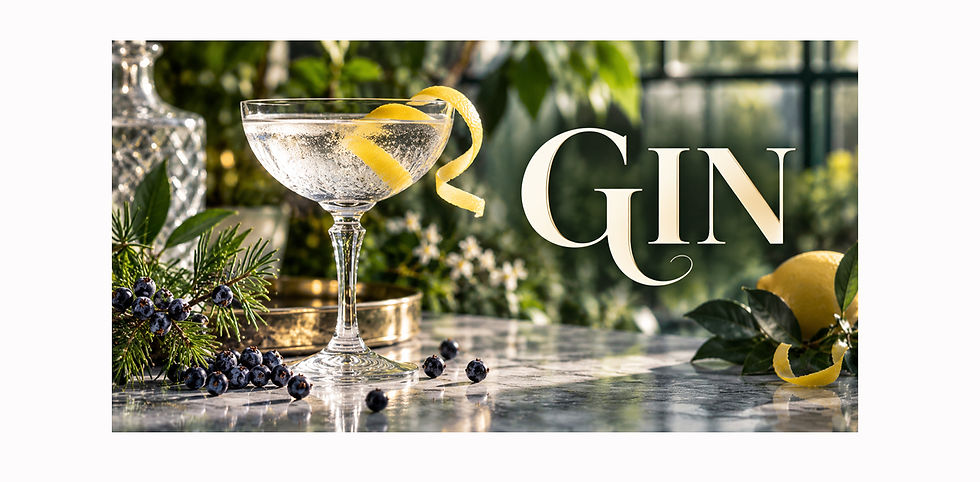


La Hollande a fait du genièvre (également orthographié genièvre), et c'est ce que les Anglais ont essayé de reproduire.
Techniquement, on peut dire que le gin a été la première vodka aromatisée .
Le gin a été donné aux soldats hollandais sous le surnom de "Dutch Courage".
Guillaume d'Orange a apporté le genièvre de Hollande en Angleterre.
De nombreuses herbes et plantes sont utilisées dans le gin, mais la baie de genévrier donne la saveur prédominante.
Le premier gin commercial d'Angleterre s'appelait Old Tom. C'était un gin doux un peu comme le genièvre.
Dans les années 1700, les Anglais étaient autorisés à fabriquer du gin sans licence.
Le gin peut être fabriqué partout dans le monde.
Le gin était l'alcool de base original utilisé dans le Martini. L'image du verre à Martini est le symbole de la culture du cocktail le plus emblématique au monde. Parmi les autres cocktails à base de gin populaires, citons Tom Collins, Singapore Sling, Negroni, Ramos Gin Fizz, Gimlet et Monkey Gland.
Types de Gin
Le gin peut être fabriqué n'importe où dans le monde, mais les principaux pays qui le produisent sont les États-Unis, le Japon, la France, l'Espagne, la Suède, le Canada, l'Écosse et l'Allemagne, tout comme le continent africain. Il existe quatre catégories de gin : Genever, London Dry (ou simplement Dry), Plymouth et New Western.
Genièvre (genièvre)
Le genièvre a été le premier inventé en Hollande. Il a un goût sucré et malté. Les genièvres se divisent en quatre autres catégories : Oude, jonge, korenwijn et graajenever. Oude et jonge ne peuvent être fabriqués et vendus qu'en Hollande et en Belgique.
Cliquez ici pour voir une présentation de genièvre sur SlideShare.
Londres sec (sec)
La plupart des gens y pensent quand on parle de gin. Les marques populaires sont Bombay, Beefeater et Tanqueray. Le goût est propre et sec et se mélange bien dans les cocktails.
Plymouth
Cette catégorie est pour le gin produit à Plymouth, en Angleterre. Aujourd'hui, la ville ne produit qu'un seul gin et son nom est Plymouth. Il a un goût aromatique, terreux et fruité.
Nouveau western
Ces nouveaux gins sont arrivés sur le marché au début du nouveau millénaire. La plupart d'entre eux entreraient dans la catégorie des «secs» et le genévrier semble être à l'arrière au lieu de l'avant. Les exemples comprennent Hendrick's, Aviation American et Martin Miller's.
Faits amusants sur les gins
Le gin n'est que de la vodka après sa première distillation. Les herbes et les plantes sont ajoutées lors de la deuxième distillation. Il est juste de dire que le gin est une vodka aromatisée.
Presque aucun genévrier n'est cultivé; il est principalement cueilli à l'état sauvage.
Aujourd'hui, les Philippines consomment plus de gin que n'importe quel pays du monde (25 millions de caisses annuelles).
La citation la plus célèbre de Martini est celle de la poétesse et écrivaine américaine Dorothy Parker : « J'aime avoir un Martini, deux tout au plus ; trois, je suis sous la table, quatre je suis sous mon hôte !
Le gin le plus cher est Watenshi à 2 500 $ la bouteille. Les bouteilles sont remplies avec l'évaporation (Angel's Share). Il faut cent distillations pour remplir une bouteille.
Le 11 février 2016, la plus grande dégustation de gin impliqué 796 participants, réalisé par The New World Trading Company à travers le Royaume-Uni. Il y avait neuf bars qui ont participé.
En 2018, Snoop Dog a créé le plus gros Gin & Juice pour le Guinness World Record.
J'ai mis en place un menu saisonnier / hiver 2019 Aviation American Gin au Bourbon O Jazz Bar sur Bourbon Street à la Nouvelle-Orléans.
Gin Timeline
From a 13th-century Dutch medicine cabinet to a London public health crisis to
Snoop Dogg's giant cocktail, here's gin history laid out in order — proof that no spirit has had a more dramatic career change than a little juniper berry.
13th century — One of the earliest known written references to juniper-based medicinal tonics appears in Jacob van Maerlant's Dutch work Der Naturen Bloeme.
Late 1500s — The Dutch begin producing jenever (genever), the malty,
juniper-flavored spirit that will eventually inspire English gin.
1575 — The Bols family establishes a distilling business in Amsterdam, one of the earliest and most enduring genever houses.
Mid-1600s — Hundreds of small distilleries are operating throughout the Netherlands. Jenever is firmly part of Dutch drinking culture.
1689 — Dutch-born William of Orange becomes King William III of England. His government discourages imported French brandy and encourages domestic gin production.
Early 1700s — Gin becomes cheap, plentiful, and barely regulated. London's Gin Craze begins, associated with poverty, crime, and public disorder.
1736 & 1751 — Parliament passes the Gin Act of 1736 and the Gin Act of 1751, attempting to control London's gin crisis.
1751 — William Hogarth publishes his engraving Gin Lane, capturing the era's grim reputation.
1820s–1830s — Gin's image transforms with the arrival of London's glamorous gin palaces — bright lighting, mirrors, and elaborate interiors.
Late 1800s — Old Tom Gin appears in early American cocktail books. The Martinez, an important predecessor of the Martini, combines gin and vermouth.
1888 — New Orleans bartender Henry C. Ramos creates the Ramos Gin Fizz.
1920–1933 — American Prohibition drives gin production underground, giving rise to the term "bathtub gin."
1930s–1940s — After Repeal, Hollywood glamorizes gin cocktails, especially the Martini.
2000s–2010s — The modern craft-gin revival takes off. Gin entries at the International Wine & Spirit Competition increase 200% between 2013 and 2016 alone.
2018 — Snoop Dogg helps create a record-breaking giant Gin & Juice at the BottleRock Napa Valley festival.
Les historiens du gin ont découvert que les toniques de santé à base de genévrier ont été mentionnés pour la première fois dans le livre néerlandais de 1269 Der Naturen Bioemementions de Jacob van Maerlant te Damme.
En 1575, Lucas Bulsius a changé son nom de famille en Bols, a déménagé à Amsterdam et a créé sa propre distillerie de genièvre. C'était une boisson préférée parmi les troupes britanniques qui étaient aux Pays-Bas pour la guerre d'indépendance néerlandaise (1567-1609). Ils lui ont donné un surnom : Dutch Courage. En 1600, Bols avait acquis une réputation et était un fournisseur privilégié de la puissante Compagnie hollandaise des Indes orientales. Cela lui a donné les premiers dibs sur les épices et les herbes pour faire son genièvre. Le genièvre a été mentionné dans une pièce de théâtre anglaise de 1623 intitulée Le duc de Milan. Des centaines de petites distilleries de gin hollandaises étaient en activité au milieu des années 1600.
Pietr Blower, un émigré hollandais (auto-exilé) a fait une recette spéciale de genièvre à la Barbade. Il a apporté du Brésil du matériel de distillerie et des plants de canne à sucre en 1637.
En 1672, Guillaume d'Orange (de Hollande) devient roi d'Angleterre. William a fortement influencé la fabrication généralisée du gin en Angleterre en taxant les spiritueux importés, puis a permis à quiconque de produire du gin sans licence, ce qui a conduit les distillateurs à utiliser de l'eau impure et des ingrédients toxiques et de qualité inférieure. Le gin était la boisson la moins chère de la ville et a commencé à être blâmé pour une augmentation de la criminalité, des problèmes sociaux, des accidents et de nombreux décès. Londres est devenue un bidonville de crime rempli d'ivrognes. Tout cela a conduit au « Gin Craze », au « Gin Lane », au « Gin Act of 1736 » et au « Gin Act of 1751 ». En 1721, un quart de Londres est utilisé pour la production et la vente de gin. Près de deux millions de gallons sont produits.
Entre 1825 et 1829, les premiers somptueux palais du gin de Londres ont ouvert avec un style opulent. Charles Dickens a écrit à leur sujet en 1836, les qualifiant de "parfaitement éblouissants lorsqu'ils contrastent avec l'obscurité et la saleté que nous venons de quitter".
En 1862, le barman et auteur américain Jerry Thomas a publié la première recette connue de gin Martini, appelée Martinez, dans le premier livre de cocktails connu. Le gin répertorié pour le Martini était Old Tom. En 1888, le propriétaire d'un bar de la Nouvelle-Orléans, Charles Ramos, a créé le cocktail de gin le plus populaire de la ville, le Ramos Gin Fizz. Il a également demandé du gin Old Tom .
Pendant la Prohibition américaine (1920-1933), les gangsters fabriquaient une gnôle ressemblant à du gin en infusant du clair de lune de contrebande avec des baies de genévrier séchées, et dans les années 1940, le gin a été transformé en un esprit glamour avec l'aide de stars de cinéma et de films hollywoodiens.
Photo de Aviationgin.com

Domaine public

Domaine public

Domaine public
Fun Gin Facts
Gin and vodka are close cousins. Many gins begin with a neutral spirit much like vodka. The difference comes when juniper and other botanicals are introduced to give gin its distinctive flavor.
Think of vodka as showing up naked. Gin accessorizes.
Juniper berries aren't actually berries. Botanically speaking, they're the fleshy seed cones of the juniper plant.
So gin has been lying to us about the berries this entire time.
Most juniper used for gin is wild-harvested rather than commercially farmed. Pickers gather the tiny cones from naturally growing juniper shrubs, particularly throughout Europe.
Imagine explaining your occupation at a party: “I pick gin berries.”
The Philippines has historically been the world's largest national gin market. Gin is enormously popular there, particularly the locally produced Ginebra San Miguel. Apparently, England started the Gin Craze, and the Philippines said, “We'll take it from here.”
Gin can be made from some surprising things. The base alcohol can originate from grains, grapes, potatoes, sugar beets, or other fermentable agricultural ingredients. What makes the finished spirit gin is its botanical character—most importantly, juniper. There is no official botanical limit. Gin makers can experiment with citrus peels, coriander, cucumber, flowers, tea, peppercorns, herbs, spices, seaweed, and countless other ingredients.
Basically, gin distillers are the people who look around the garden and think, “I wonder what that tastes like at 80 proof.”
One of the world's most extravagant gins is Watenshi. Cambridge Distillery produces it by capturing extraordinarily small quantities of spirit normally lost during distillation. Watenshi has recently been priced at about £3,000 ($4,000) per bottle.
At that price, I'm going to need you to measure my Gin & Tonic with an eyedropper.
The Guinness World Record for the most expensive bottle of gin has belonged to MORUS LXIV. A bottle sold in London in 2018 for £3,800, approximately $4,888 at the time.
And suddenly the well gin doesn't look so bad.
Gin doesn't have to come from England. Unlike geographically protected spirits such as Cognac, gin can be produced around the world. Today you'll find excellent examples from Japan, Spain, Germany, the United States, Australia, South Africa, Sweden, and many other countries. International gin competitions now recognize producers from all over the globe.
London Dry Gin doesn't have to be made in London. “London Dry” refers to a production style, not an address.
London would probably like a word with whoever came up with that naming system.
Navy-strength gin is seriously strong. It's traditionally bottled at about 57% ABV. The style is associated with the British Royal Navy and the strength at which spilled spirit could still allow gunpowder to ignite.
That's one way to conduct quality control.
Gin nearly lost its cool—and then came roaring back. The modern craft-gin revival exploded in the 2000s and 2010s. At the International Wine & Spirit Competition, gin entries increased 200% between 2013 and 2016 alone.
In 2018, Snoop Dogg helped make a record-breaking Gin & Juice. Snoop Dogg, Warren G and others created an enormous cocktail at the BottleRock Napa Valley festival using gin, juice, and a giant drinking vessel. Because apparently a regular Gin & Juice wasn't Snoop enough.
The Martini glass became an international shorthand for “cocktail.” You see its V-shaped silhouette on bar signs, cocktail menus, neon lights, logos, invitations, and cocktail-hour graphics around the world—even when there isn't a Martini anywhere in sight.
It's basically the cocktail world's version of the peace sign.
Types of Gin
Gin is now made around the world, and today's bottles don't always fit neatly into four boxes. But these are some of the major styles worth knowing:
Genever (Jenever)
The Dutch ancestor of modern gin. Genever generally has a richer, maltier character than London Dry Gin and can taste closer to a meeting between gin and whiskey.
Traditional classifications include jonge, oude, and korenwijn. And confusingly, jonge and oude don't simply mean the genever is young or old—they refer primarily to the style and production method.
Apparently, ordering Dutch liquor required a vocabulary test.
London Dry
This is the classic gin profile most people recognize: dry, crisp, botanical, and juniper-forward. Familiar examples include Beefeater, Tanqueray, and Bombay Sapphire.
And despite the name, London Dry Gin does not have to be made in London. “London Dry” describes how the gin is produced, not its mailing address.
Plymouth Gin
Unlike London Dry, Plymouth Gin is geographically tied to Plymouth, England. Today, Plymouth Gin is the best-known—and historically defining—example of the style. It tends to be softer and earthier than a traditional London Dry, with less aggressive juniper.
Old Tom
A historic style that is generally a little sweeter and rounder than London Dry. Old Tom nearly disappeared during the 20th century before the craft-cocktail revival brought it back.
Bartenders started digging through old cocktail books and realized we'd misplaced an entire gin.
Contemporary / New Western Gin
Beginning around the turn of the 21st century, distillers increasingly produced gins in which juniper shared the spotlight with other botanicals. Citrus, cucumber, flowers, herbs, and spices could become much more prominent.
Hendrick's and Aviation helped popularize this modern approach.
Juniper is still there—it just finally learned how to share the microphone.