
Bar Tricks & Bar Magic Tricks
In the 1980s, I saw my first bar trick at the Cabaret bar in Little Rock, Arkansas, from a gregarious patron named Daddy Jack.
He used the cherry that I dropped into his Manhattan, a brandy snifter, and an ashtray.
In the first fifteen years of tending bar, my collection grew to almost 1000 tricks (tending bar in tourist destinations allowed the collection to grow faster).
It was my thing behind the bar. Some bartenders collected tips; apparently, I collected ways to keep people from leaving. And to be perfectly honest, I love performing bar tricks and entertaining people (watching their facial expressions is my favorite part), but it was also about money. I watched my tips double, triple, and sometimes even quadruple.
In the 1990s, while working at Walt Disney World, I was asked to teach my top 10
cream-of-the-crop bar tricks in WDW's mandatory F&B classes called Quest for the Best.
In 2000, this experience inspired me to publish my first bar trick book,
Miss Charming's Book of Bar Amusements. And in 2002, a children's magic book kit,
Be A Star Magician.
Bar Tricks, Bar Magician History & the Story
of Bar Magic
Ancient wall paintings show us that tricks have been around since 5000 BCE. The classic cup-and-ball trick appears in detailed Egyptian scrolls. India had its snake charmers and carpet flyers; court jesters performed for royalty; and throughout history, speculation is high that the average Jane or Julius witnessed a few shenanigans of sorts at local village drinking houses.
In medieval times, however, tricks fell into a Dark Age closet due to the association with witchcraft, and it wasn’t safe to come out and play again until the 1700s.
A Bar Trick is a challenging brainteaser of sorts using a variety of items found in and around a bar or restaurant. Traditionally, those items included coins, bills, straws, glasses, bottles, cocktail napkins, matches, and even ashes from ashtrays.
Bartenders use bar tricks to entertain guests because most take only ten to twenty seconds to set up and explain, letting the bartender walk away and tend to other duties while guests have fun trying to figure them out.
Of course, times have changed. Many of the everyday props used in classic bar tricks are quietly disappearing from bars. Guests pay with cards or phones instead of coins and bills, straws may be available only on request, and ashtrays, ashes, and matches have disappeared from most American bars along with indoor smoking.
Apparently, even bar tricks have fallen victim to technology, sustainability, and clean indoor air.
But here's a funny reversal: eggs came back! For years, whenever I wanted to perform my egg-and-shot-glasses trick, I had to bring my own egg from home because most bars didn't keep raw eggs around. Then the craft cocktail movement revived egg-white cocktails, and suddenly plenty of eggs were behind the bar. I waited decades for bartending to catch up with my bar trick. 😂
Fortunately, plenty of classics still work with glasses, bottles, napkins, and other things you'll find behind a modern bar—and some bar tricks require no props at all, relying instead on wordplay, riddles, and good old-fashioned gags.
Basically, it’s the bartender’s version of giving you a puzzle to play with so we can go make twelve other drinks.
Bar Magic Tricks
A bar magic trick is magic performed using a variety of items found in and around
a bar/restaurant or with store-bought magic tricks.
Bar magic tricks require a little more time to prepare, present, and perform.
Generally, bartenders only take the time to perform a bar magic trick when they aren’t busy making cocktails for other guests.
1800s–Early 1900s: Foundations (Showmanship, Not Yet “Bar Magic”)
1830s–1880s – Jerry “The Professor” Thomas (1830–1885)
-
Role: Bartender and author of The Bar-Tender’s Guide (1862); turned drink
-
mixing into theatrical performance.
-
Contribution to bar trick culture: Famous for the Blue Blazer (flaming whiskey poured between two mugs), bottle/cup juggling, and lavish showmanship; set the precedent that bartenders could be entertainers, not just servers.
-
Note: Not a “bar magician” in the close-up sense, but a direct ancestor of performance bartending and bar amusements.
Late 1800s–Early 1900s – Vaudeville & Early “Bar Acts”
-
Context: Magicians performed on stages; some incorporated bar-themed routines (e.g., producing drinks, “inexhaustible bottle” effects), but these were primarily stage acts, not tableside bar magic.
-
Key effect: The Inexhaustible Bottle (17th-century origin) evolved into later bar-themed routines like Any Drink Called For / Think-a-Drink.
1910s–1930s: Birth of Chicago-Style Bar Magic
1914–1915 – Schulien’s Opens; Matt Schulien Begins Tableside Magic
-
Venue: Schulien’s German restaurant/saloon at 1800 N. Halsted, Chicago.
-
Performer: Matt Schulien (1890–1967), the owner's son, began greeting tables and performing close-up card tricks and stunts after Prohibition ended.
-
Innovation: Moved magic from distant stages to inches-from-the-guest tableside experience, mixing humor, cards, and bar-room interaction; this became known as Chicago-style magic.
1919–1933 – Johnny Platt (1903–1990) Early Career
-
Early work: Began as “La Platt” (1919); performed as Hadji Baba at the 1933 Chicago World’s Fair.
-
Bar connection: Later became a long-time MC/magician in the Gay Nineties Tap Room at Chicago’s LaSalle Hotel, sharing that space with other bar magicians like Johnny Paul and Frank Everhart, Sr.
1920s–1930s – Prohibition & Speakeasy Entertainment
-
Context: Illegal bars encouraged intimate entertainment; magicians and entertainers worked in speakeasies, though documentation of specific “bar magicians” from this exact period is spotty.
-
Effect lineage: Bar-themed magic effects (producing drinks, vanishes, transformations) fit naturally into speakeasy culture, setting up later formal “bar acts.”
1930s–1960s: Golden Age of Chicago Bar Magic
1930s–1960s – Think-a-Drink Hoffman (Charles “Think-a-Drink” Hoffman, c. 1895/96–1965/66)
-
Role: Vaudeville magician with a bar-themed act; often billed as “The Highest Paid Bartender in the World.”
-
Signature routine: Any Drink Called For / Think-a-Drink—producing any cocktail requested by the audience from apparently empty shakers/bottles using a trick “inexhaustible” bottle.
-
Relevance: Though primarily a stage performer, his entire persona was that of a bartender-magician, and his effect became a cornerstone of bar-magic literature and repertoire.
1940s–1980s – Proliferation of Chicago Magic Bars
Venues: By the 1940s–1960s, Chicago had 15+ magic bars/restaurants, including:
- New York Lounge (opened 1945)
-
Johnny Paul’s Magic Lounge (Cicero)
-
Little Bit O’ Magic (South Side, 1970s)
-
Frank Everhart’s Magic Bar (in the Ivanhoe Theater)
-
Mr. C’s Magic Lounge (Berwyn), Houdini’s Pub, Magic Touch, and others.
Style: Close-up magic performed while guests drank and dined; many performers were effectively bartender-magicians or “house magicians” in bar settings.
-
1949–1991 – “Heba Haba” Al Andrucci (c. 1914–1991)
Role: One of the fathers of bartending magic; performed from the 1960s into the 1980s, becoming synonymous with Chicago bar magic.
-
Venues: Worked at Schulien’s, New York Lounge, Pickle Barrel, and ran his own Heba Haba’s Magic Bar (Rogers Park Hotel) after WWII.
-
Signature contributions: Popularized effects like Card Under Glass; known for sponge rabbits, multiplying objects, and his “Heba Haba” catchphrase.
1950s–1970s – Johnny Paul
(mid-1900s)
Role: Bartender-magician at the LaSalle Hotel (Gay Nineties Tap Room) in Chicago; credited with instituting “Bar Magic” as a distinct style.
-
Style: Juggled bottles and performed jokes, gags, and close-up magic behind the bar (not just tableside), blending service with performance.
-
Impact: Inspired a wave of themed “magic bars” across Chicago; part of the same ecosystem as Johnny Platt and Frank Everhart, Sr.
1950s–1990s – Frank Everhart, Sr. (1921–2004)
-
Early career: Learned bartending in San Diego (El Cortez Hotel); moved to Chicago by 1949, working the Gay 90’s Room at the Hotel LaSalle, where Johnny Platt was the house magician.
-
Chicago residency: Ran Frank’s Magic Bar for ~21–24 years at the Ivanhoe Theater, establishing a long-running comedy/bar magic show.
-
Signature tricks: Famous for “Sam the Bellhop” and “Red Hot Mama” card routines; embodied the classic magic bartender persona.
1960s–1970s – Don Alan (mid-1900s)
-
Role: Chicago magician and TV host (Don Alan’s Magic Ranch); part of the same close-up/bar magic scene.
-
Connection: Associated with Chicago magic bars and TV exposure of close-up magic; appeared alongside or in the same circles as Johnny Platt and other bar magicians.
1970s–2000s: Modern Bar Magic Residencies & Documentation
1977–2004 – Doc Eason (b. 1947)
-
Venue: John Denver’s World Famous Tower Comedy/Magic Bar, Snowmass Village, Colorado.
-
Role: Full-time bar magician in residence for 27 years; performed intimate close-up magic inches from guests, blending sleight-of-hand, humor, and storytelling.
-
Recognition: Multiple Magic Castle awards:
-
First-ever W.C. Fields Magic Bartender of the Year (2004)
-
Close-Up Magician of the Year (twice)
-
Lecturer of the Year (multiple times)
-
Bar Magician of the Year
-
-
Impact: Became a benchmark for what a modern bar magic residency could be; his performances are studied as masterclasses in audience management and routining.
1980s–1990s – Jamy Ian Swiss (b. 1961)
-
Role: Close-up magician who worked as Magic Bartender at the Inn of Magic (Maryland suburbs of Washington, DC), c. 1985–86.
-
Contribution: Developed his own Card Under Glass routine, explicitly citing Heba Haba Al as the creator of that classic Magic Bar effect; later wrote about the history of Magic Bar in Genii and his book Shattering Illusions.
-
Relevance: Represents the second generation of bar magicians consciously building on the Chicago tradition.
1980s–2000 – Cheryl Charming That's me! (b. 1960)
-
Role: Bartender and author; collected and codified bar tricks, magic, toasts, and social amusements.
-
Career highlights:
-
Worked on a cruise ship for four years, then at Walt Disney World, where she became known for bar tricks and began teaching bar amusements to other cast members via the Quest for the Best program.
-
Bar Director at the Bourbon “O” Bar (New Orleans); named New Orleans Magazine Mixologist of the Year (2014).
-
-
Publications:
-
Miss Charming’s Book of Bar Amusements (2000) – compiled nearly 1,000 bar tricks, including magic effects using matches, toothpicks, glasses, coins, bottles, and napkins and Be A Star Magician kit (2003) for children.
-
Over 18 books on cocktails, bartending, and party hosting.
-
-
Contribution: Provided the most comprehensive printed reference on bar tricks and bar magic for working bartenders.
Dean Serneels – Bar Magician, Trick Inventor, and Flair Pioneer
Dean Serneels (often called “The Mad Mixologist”) is best known in the drinks world as an award-winning flair bartender and inventor of the Flairco Flair bottle and Flairco portable bar, as well as a set of four award-winning bartender training DVDs. But he also has deep roots in bar magic and bar tricks, with his own line of bar-magic effects—most famously the floating cocktail shaker.
Early Career: Tableside Magic in Canada
Before his flair fame, Serneels began as a tableside magician in Canadian restaurants, performing close-up magic for diners in the style of the classic Chicago bar-magic tradition. He started entertaining guests with magic tricks and sleight of hand early in his bartending career, which led him to work as house magician (5–8 p.m.) and head bartender at Philthy McNasty’s, a sports bar in Ontario. This dual identity—bartender by trade, magician by performance—shaped his later inventions and teaching.
Bar Magic Contributions
Serneels bridges the gap between flair and bar magic:
-
Floating Cocktail Shaker: His most popular bar-magic effect, a levitation-style illusion where a metal shaker appears to float in midair while he pours or gestures. This trick has become a signature “cocktail magic” routine, often performed as a homage to him in modern flair/magic circles.barstarspodcast+1
-
Bar Magic Product Line: He developed and marketed a line of bar magic tricks aimed at working bartenders, emphasizing effects that can be done with standard bar tools (shakers, jiggers, bottles, napkins, etc.).bartendbetternow+1
-
Teaching & Influence: Through his DVDs, lectures, and competition work (as judge, emcee, and sponsor), he has taught bartenders how to blend showmanship, sleight of hand, and drink-making into a cohesive bar performance
1990s–1999 – Final Closure of the Original Chicago Magic Bars
-
Milestone: Most Chicago magic bars closed by the late 1980s;
-
Schulien’s—the first and longest-running—closed in 1999, marking the end of the original era.
-
Legacy: The model of bar/resaurant magic lived on through individual performers and later revivals (e.g., Chicago Magic Lounge).
1990s–Present: Second-Generation & Contemporary Bar Magicians
1990s–Present – Frank Everhart, Jr. (b. 1973)
-
Role: Second-generation bar magician; son of Frank Everhart, Sr.
-
Venues:
-
Originally ran Frank’s Magic Bar on Laclede’s Landing (St. Louis area) for ~4 years.
-
Since the late 1990s, performs nightly at Schooner Wharf Bar in Key West, Florida, where his show is billed as Frank’s Magic Bar.
-
-
Recognition: Recognized by the International Brotherhood of Magicians as one of the foremost authorities in bar magic today.
-
Style: Close-up card magic, comedy, and audience participation in a casual dockside bar; continues his father’s tradition of comedy bar magic.
2000s–Present – Smoothini (Tomas B. De La Cruz, Jr.; b. 1980)
-
Role: Bar and street magician based in Las Vegas; TV personality (“Hip Hop Houdini,” America’s Got Talent semi-finalist).
-
Relevance to bar magic:
-
Performs close-up and bar-style magic in clubs and lounges; often billed as the “#1 Bar Magician in Las Vegas.”
-
While his brand is more “street/hip-hop magic,” his core work is close-up magic in bar/club environments, continuing the bartender/magician overlap in a modern, media-driven form.
2010s–Present – Chicago Magic Lounge & Revival Venues
-
-
Venue: Chicago Magic Lounge (Uptown Chicago) explicitly revives the Chicago-style magic bar tradition.timeout+2
-
Performers: Features magicians who perform close-up/tableside magic in a bar/lounge setting, in the lineage of Matt Schulien, Heba Haba Al, and Johnny Paul.timeout+1
-
Significance: Provides a contemporary space where bar magic as a genre is consciously preserved and presented to new audiences.
Bar Tricks From My 1st Book:
Miss Charming's Book of Bar Amusements.
These easy bar tricks and bartender tricks take just seconds to set up.
This book is out of print, but you can still buy a used one on Amazon.


Bottle & Straw trick
This is a good follow-up trick to the bottle trick in the above image.
Items needed: a twelve-ounce bottle and a drinking straw
Setup: Set out the empty bottle and drinking straw on a table or bar top.
The Challenge: Pick up the bottle at least six inches using only the straw.
You cannot wrap the straw around the outside of the bottle.
The Answer: Bend the end of the straw, then insert it into the bottle until it
catches at the bottom of the neck, then lift.
Tips: All bottlenecks are slightly different, so the spot where you bend the
straw will vary each time.
The Egg and Shot Glasses trick
This is my top climactic trick. I only pull it out once I have a small crowd, because they go nuts when you reveal the answer. Then I encourage each
of them to try it, and it's hilarious. A bunch of "blowing" jokes seem to be voiced.
Items needed: an egg (raw or hard-boiled), two heavy-bottomed shot glasses.
(see Tips)
Setup: Place the shot glasses side by side on a table or bar top. Place the egg into one of the shot glasses.
The Challenge: Move the egg into the empty shot glass without touching the egg or the shot glasses with anything.
The Answer: Blow a short, quick, and hard stream of air into the air pocket of the shot glass that is holding the egg, and the egg will pop over to the other shot glass. The air pocket is between the egg and the rim of the glass. Click here to see a YouTube video of me doing it.
Tips: Hard-boil an egg to save eggs and reduce mess. The best shot glasses to use are old-fashioned types with a heavy glass bottom. Search Libbey 5127 shot glasses to get an idea. If you use another type of shot glass, make sure it leaves at least an eighth of an inch of air pocket space after you insert the egg.
1+2+3=4 trick
This is a good setup for a time stretcher. It will probably buy you 5-10 minutes before you need to return, so you can help other guests in between. Items needed: Ten cocktail straws. Other items you can use include toothpicks, matchsticks, and cocktail picks.
Setup: Arrange the ten straws to read the equation:
1 + 11 + 111 (1+2+3).
The Challenge: Pick up one straw, then place it back down somewhere in the equation so that it equals four.
The Answer: Pick up one of the straws from the number two spot and make a plus sign from the middle straw in the number three spot. It will read 1+1+1+1.
Tips: To avoid many crazy solutions with multiplication, division, and crazy-shaped numbers, let the challenged person/people know that the answer will remain a first-grade elementary mathematical equation with no multiplication, division, or crazy-shaped numbers.

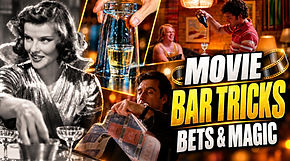
Bar Tricks in Media
1938
Film | Bringing Up Baby
A bartender does an olive bar trick.
1983
TV | Cheers
Harry "The Hat" Anderson did many bar tricks on the show.
The Hat Whiskey Trick
The Floating Coin Bet
The Cash Change Swindle
The Fake Bar Bulldozing Scam
The Poker Hustle
1997
Film | Boogie Nights
Reed (John C. Reilly) performs a
bar magic trick.
🍿 ROLL THE CLIP →
2002
Film | The Recruit
Al Pacino's character, a bar patron, performs a bar trick with a newspaper.
🍿 ROLL THE CLIP →
2014
TV | America's Got Talent Season 9
2018
TV Movie | Two Magicians Walk Into a Bar
Close-up and stage magic routines performed in New Orleans.

Doc Eason, me, and Dean Serneels teaching a Bar Magic Seminar at Tales of the Cocktail.


Johnny Platt.


